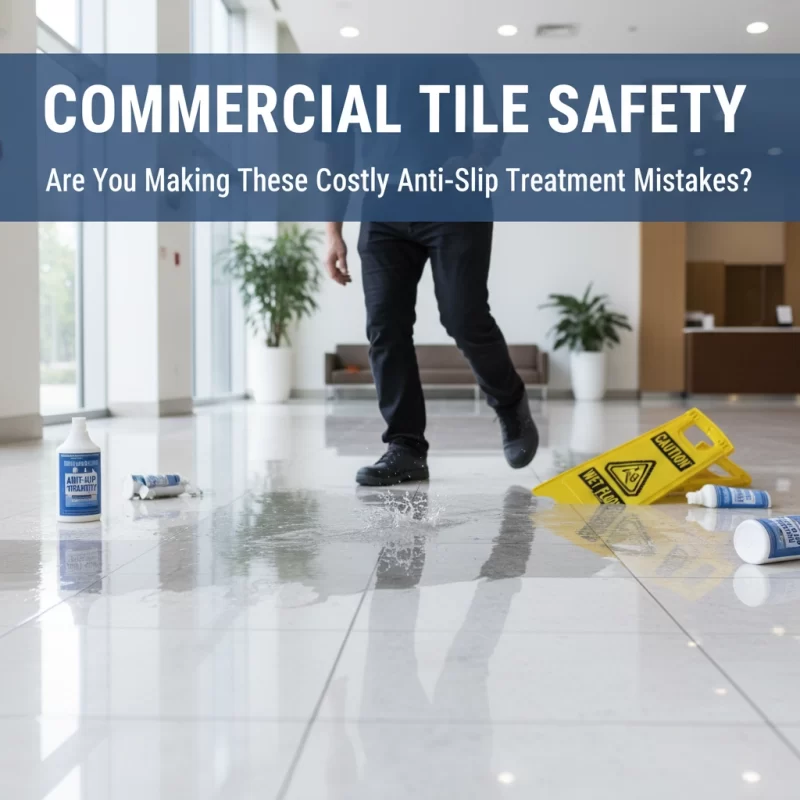
Slip and fall accidents cost U.S. businesses over $11 billion annually, with commercial tile floors being a major contributing factor. While anti-slip treatments seem like the obvious solution, many business owners unknowingly make critical mistakes that not only waste money but actually increase liability risks.
If you’re responsible for commercial facility safety, the anti-slip treatment decisions you make today could determine whether you’re protecting your business or setting yourself up for costly lawsuits tomorrow.
The Hidden Dangers of DIY Anti-Slip Applications
Uneven Coverage Creates Liability Hotspots
One of the most expensive mistakes in commercial anti-slip treatment is uneven application. When treatments are applied with rollers or spray equipment without proper technique, you create inconsistent traction zones across your floor surface.
Picture this: an employee walks confidently across a properly treated section of your warehouse floor, then suddenly hits an untreated patch and goes down hard. The inconsistency makes the accident more likely because people adjust their gait based on expected traction.
The costly reality: Pooling and overlapping during application doesn’t just waste product: it creates unpredictable walking surfaces that increase accident risk. Areas with excessive product buildup can actually become too grippy, causing people to trip when their shoes don’t release as expected.
Choosing the Wrong Treatment for Your Tile Type
Not all commercial tiles respond the same way to anti-slip treatments. Porcelain, ceramic, natural stone, and quarry tiles each have different surface characteristics that require specific treatment approaches.

Common mistake: Applying a one-size-fits-all coating to granite floors in your restaurant kitchen when you should be using a treatment specifically formulated for natural stone surfaces. The result? Poor adhesion, reduced effectiveness, and money down the drain within months.
The science behind it: Different tile materials have varying porosity levels and surface textures. A treatment that works beautifully on ceramic tile might fail completely on polished marble because it can’t properly penetrate the surface.
Maintenance Mistakes That Sabotage Your Investment
The Soap Residue Trap
Here’s an ironic twist: many facilities invest thousands in anti-slip treatments, then immediately undermine them with improper cleaning practices. Using excessive amounts of commercial floor cleaners creates slippery soap residue that defeats the entire purpose of your anti-slip investment.
What happens: Your cleaning crew applies heavy-duty degreaser to your restaurant’s tile floor, but doesn’t properly rinse and dry the surface. The remaining soap film makes the floor more slippery than it was before treatment.
Ignoring Spill Response Protocols
Even the best anti-slip treatment can’t overcome standing water or spilled liquids. Commercial kitchens, manufacturing facilities, and retail spaces need immediate spill response protocols: yet many businesses focus solely on the treatment and ignore ongoing maintenance.

The numbers: A wet floor can be up to 100 times more slippery than a properly maintained dry surface, regardless of anti-slip treatment quality.
Strategic Errors That Cost More Than Money
The Wax and Sealant Mistake
This might be the most counterproductive mistake of all: applying traditional floor wax or sealant over anti-slip treatments. It sounds logical: you want to protect your investment and keep your floors looking good. But wax fills in the microscopic pores and surface texture that create traction.
What you get: Floors that look great but are more dangerous than before you started. You’ve essentially paid twice: once for anti-slip treatment, then again to eliminate its effectiveness.
Skipping Professional Assessment
Many business owners choose anti-slip products based on price or availability rather than consulting with slip resistance professionals. This approach often leads to selecting treatments that don’t match your specific traffic patterns, environmental conditions, or regulatory requirements.
Industry insight: Different commercial environments require different slip resistance coefficients. A treatment suitable for a low-traffic office lobby won’t meet the safety demands of a busy restaurant kitchen or manufacturing floor.

The Right Way to Approach Commercial Anti-Slip Safety
Surface Preparation Makes the Difference
Professional anti-slip treatment starts with proper surface preparation. This means thoroughly cleaning the tile, removing any existing sealants or coatings, and ensuring the surface is completely dry before application.
Pro tip: Surface preparation accounts for up to 80% of treatment success. Skipping or rushing this step almost guarantees poor results, regardless of product quality.
Matching Treatment to Traffic and Environment
High-traffic commercial areas need deep-penetrating treatments that become part of the tile structure rather than surface coatings that wear away. These treatments typically cost more upfront but provide superior long-term value in demanding environments.
Consider these factors:
- Daily foot traffic volume
- Exposure to water, grease, or other contaminants
- Cleaning chemical requirements
- Temperature fluctuations
- Regulatory compliance needs
Establishing Proper Maintenance Protocols
Effective anti-slip treatment requires ongoing maintenance protocols tailored to your specific environment. This includes:
Daily practices: Immediate spill cleanup, proper cleaning product selection, and thorough surface drying after cleaning.
Weekly maintenance: Deep cleaning to remove accumulated contaminants that can reduce traction effectiveness.
Quarterly assessments: Professional evaluation of treatment condition and performance to identify areas needing attention before problems develop.

Advanced Solutions for Maximum Protection
Nano Coating Technology
Modern nano coatings create microscopic surface texture that improves traction without changing the appearance of your tile. These treatments work immediately after application and maintain effectiveness longer than traditional anti-slip products.
Benefits for commercial use:
- Invisible application maintains aesthetic appeal
- Superior durability under heavy traffic
- Easier maintenance compared to surface coatings
- Compatible with existing cleaning protocols
Integrated Safety Systems
The most effective commercial safety approach combines proper anti-slip treatment with complementary measures like strategic drainage, appropriate lighting, and clear hazard identification.
Making the Right Investment Decision
Anti-slip treatment for commercial tile isn’t just about preventing accidents: it’s about protecting your business from liability, maintaining operational efficiency, and creating a safe environment for employees and customers.
The bottom line: Mistakes in anti-slip treatment selection and maintenance don’t just waste money: they can actually increase your liability risk while giving you false confidence in your safety measures.
When you’re ready to implement proper anti-slip treatment for your commercial facility, professional consultation ensures you avoid these costly mistakes while getting maximum protection for your investment.
Contact 1 Day Grout Restoration to discuss your commercial tile safety needs and learn about proven anti-slip solutions that work in real-world commercial environments.